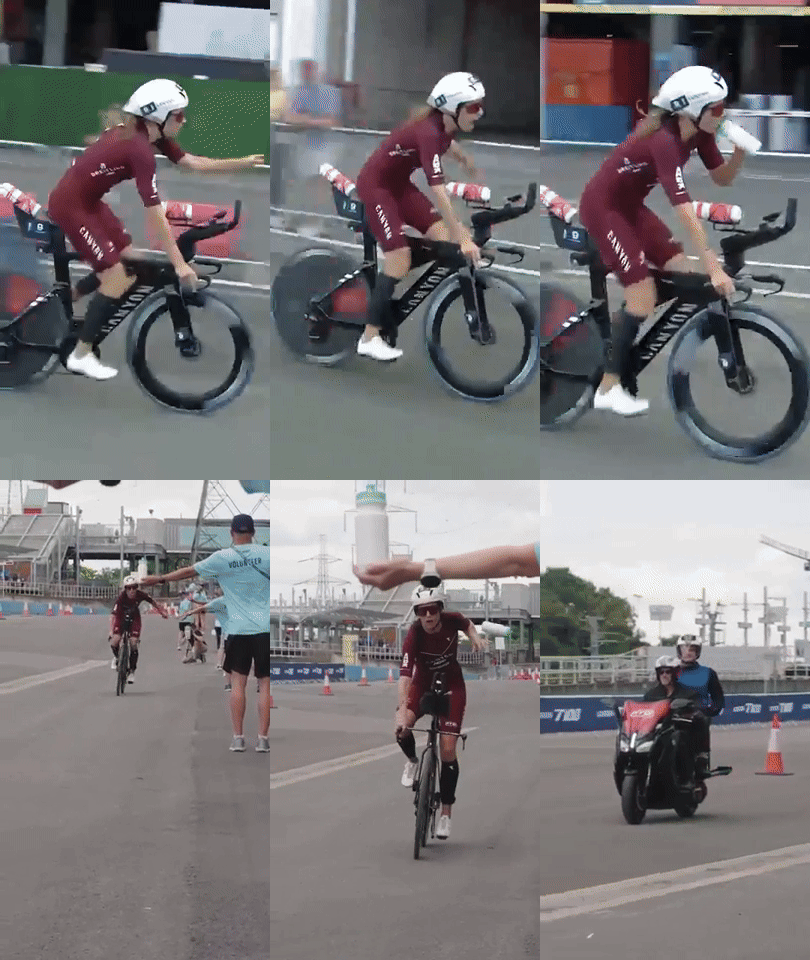
It Enables Amateur Racers
Bike racing can be daunting for new comers and experienced racers alike. There’s a lot to juggle on race day, and numerous problems can derail a performance such as a flat tire, a mechanical, or a crash to name a few. Improper race day nutrition will leave the best of racers unable to perform – racers need to consume carbohydrates, fluids, and electrolytes while riding. Riders need at least one bottle of water with electrolytes per hour in a bike race, and the vast majority of bike racers opt to consume their carbohydrates by drinking bottles full of dissolved carb mixes. The Bottle Grab allows for amateur racers to refuel and get the bottles they need in a race without any hassle. No need to drag your girlfriend to the middle of nowhere at 5 am to hand you bottles every hour. No need for a teammate’s dad to juggle bottles for the entire team spread across different fields. No risk for getting someone else’s bottle with a mix that doesn’t work for you. No need to worry about a soigneur missing or mistiming your hand-off. The Bottle Grab enables racers to compete in and perform at any race, whether it be on the road, gravel, or mountain bike.
It Improves Bottle Hand Off Success Rate
Even when a racer has a soigneur in the feed zone to hand off their bottles, the rider doesn’t always come away with a bottle. Feed zones are chaotic, soigneurs aren’t always paying attention, riders sometimes can’t find their soigneur, and the hand off isn’t always executed well enough. The Bottle Grab allows racers to know exactly where to get their hand-off, keeps bottles at a standstill for perfect hand-off execution, and reduces human error. The Bottle Grab holds bottles at a fixed height and lateral position and allow bottles to be properly grabbed from the bottom. Bottles are able to be suspended at an optimal angle for bottle hand off success.
Oier Lazkano missed a feed in Stage 8 of the 2024 Vuelta a España due to poor coordination with the Movistar Team Soigneur.
It Makes Feed Zones Safer for Riders
When bottles are dropped, they often tumble through the peloton like a land mine, causing crashes when they get under the wheels of unlucky riders. Improving hand off success rate decreases the frequency of loose bottles rolling through the peloton.
Lawson Craddock, currently one of the best American professional road cyclists, crashed due to hitting a dropped bottle in Stage 1 of his first Tour de France in 2018, breaking his scapula.
Owainn Doull of EF Education – Nippo crashed in the 2022 Tour de France after riding over a dropped water bottle.
Feed zones are chaotic. Riders are looking off to the side trying to pick out their soigneur while navigating the pack before diverting from their line to get to the side of the road. There are many soigneurs on the side of the road, moving from their position to get to their rider. Both parties are shouting, and human error also causes confusion and chaos. The Bottle Grab minimizes human error, reduces the number of soigneurs on the side of the road, and allows for riders to more easily pick out where to get their feed.
A controversy in the 2022 Tour de France, Thibaut Pinot was struck in the face by the arm of a soigneur trying to reach to a rider deeper in the peloton
A crash occurred in one of the feed zones of Stage 3 of the 2025 Tour Down Under
It Improves Safety for Soigneurs
In amateur and professional bike racing, it can be dangerous to be standing on the side of the course. Road racing offers the most dangerous road side conditions, with packs of hundreds of riders going by at speeds of often over 30 mph.
It is even more dangerous for soigneurs – those designated to hand off bottles and nutrition to riders. They have to get within arms reach of the riders, and a lot can go wrong. Collisions can occur between soigneurs and riders. Even worse, collisions can occur between soigneurs and the various motorcycles and team cars are going by as well. A soigneur was badly injured after being hit by a race official’s car in a women’s professional race in 2006.
A rider nearly collided with a soigneur in one of the spring classic races in 2024.
Though not in a feed zone but rather another in chaotic situation during a race, Alberto Bettiol collided with a team staff member trying to assist a rider after a crash.
Just handing off a bottle can leave a soigneur or rider injured as well. Without proper technique or when riders are going at excessive speeds, soigneurs as well as riders can injure their hands, fingers, arms, and shoulders from bottle hand offs by tearing muscles or ligaments.
“The feed zone is a very dangerous place. Every time you do it, when you feel that bag go out of your hand and you don’t hear metal scraping on the tarmac, you breathe an inner sigh of relief.”
In fact, Beckett still suffers from a muscle tear in his shoulder that occurred when he handed a bottle to a rider going full speed at Paris-Roubaix. He also recalls a time when former Garmin-Cervélo rider Andreas Klier tore ligaments in his thumb and crashed when the pair mistimed their bidon pass.
The Bottle Grab allows for riders to get their bottles and mussettes without the need for a soigneur to hand it off. Soigneurs are therefore able to stay out of harms way when riders, motos, and cars roll through the feed zone.
It Reduces Soigneur Duties and Costs for Professional Road Teams
“It’s a long day, they are on call from very early in the morning to last thing at night. It looks glamorous from the outside, but it’s a hard, hard job.”
Soigneurs are often the first ones in the team up in the morning, and among the last to go to bed. Days can start at 6am and not finish until 10pm.
The job requirements form an endless list which includes taking riders to and from airports, doing the food shopping, making breakfast, washing kit, filling the bidons and musettes for races, handing them out in the feed zone and waiting for the riders at the race finish line, washing the team cars, driving, pinning on numbers and repairing broken kit.
Soigneurs for professional road teams have a crazy schedule and a never-ending list of responsibilities at bike races, and they don’t exactly get paid much.
Professional bike racing is perhaps only lucrative for the sport top stars. Teams often struggle to find sponsorships and stay afloat in today’s World Tour, including American team EF-Education Easypost, owned by former US Postal Rider Jonathan Vaughters.
“I don’t know of any team that is making a profit under the current situation,” said Vaughters. “I know a lot of teams are usually losing money and they will get the losses at the end of the year covered by an owner or a wealthy donor or whatever.
“In fact, I don’t actually know a team ever that has been, by typical definition, profitable.”
– Velo’s “Behind the scenes of the pro cycling business model” circa 2015
Being an owner of a professional cycling team is an endless focus on maintaining current and finding new sponsors. Hitting the big screen in 2023, Enter The Slipstream documents team EF’s and Vaughter’s struggle to secure sponsorship and team funding in 2020.
The Bottle Grab allows for less soigneurs needed out on the road. One soigneur can set up a Bottle Grab at each feed zone location along the course instead of their needing to be at least one soigneur at each feed zone. This allows for teams to employ fewer soigneurs and for soigneurs to have fewer duties on race days.
It Reduces Costs for Support for Privateers and Small Teams in Gravel and Mountain Bike Racing
A rapidly growing part of the sport, particularly in the US, is gravel racing. Gravel races are usually very long – the most renown and prestigious gravel race in the world is the Unbound 200. The Unbound 200 is, you guessed it, 200 miles long, and 99% of the race is on really chunky gravel. It takes the fastest racers over 9 hours to complete it, and 2024’s slowest finisher took just over 20 hours. With the popularity in gravel exploding comes a new breed of professional racers.
The nickname for a typical professional gravel racer is a “privateer”, a professional who is not part of a team and instead sources individual sponsors, owns their media outlets (in the form of Instagram accounts, Podcasts, YouTube videos, etc.), and funds their career through sponsors and prize money. Privateers as you might have guessed usually do not have the means for a support crew for every race. The Bottle Grab allows for privateers to get the fuel they need to race long gravel races without the need to hire a support crew for every race.
Small gravel or mountain bike teams reap the same benefits as privateers and pro road teams with the Bottle Grab – saving costs and soigneur time and effort.
Long cross-country mountain bike races, called marathon mountain bike races, in the US like the Leadville Trail 100 have been around for decades – Lance Armstrong famously won the “Race Across the Sky” in 2009. They are experiencing a resurgence due to the growth of gravel racing, as demonstrated by the formation of the Life Time Grand Prix, a professional off-road racing series in the US formed in 2022. 25 of the top off-road racers in the world compete in three gravel and three mountain bike races that make up the 2025 series, including the Unbound 200 and the Leadville 100. Marathon mountain bike races draw the same racers from gravel due to the similar demands of the races in that they are often long, and thus the same issues for privateers and small teams exist for support crews in marathon mountain bike racing as they do in gravel.
It Presents an Opportunity for Branding
Having Bottle Grabs located on the side of the course presents an opportunity for branding for organizers, teams, and individuals. As mentioned earlier, cycling needs all the help it can get in terms of revenue. Bottle Grabs placed on the side of the course would be seen by spectators at the event in person and by many more over race broadcasts. Placing signs on a Bottle Grab is simple – as detailed in the design, t-slotted framing gives fastening points along the entire length and on each of the four sides of the square post and arm. Flags are also able to be fastened to a Bottle Grab. Teams, privateers, and organizers would be able to profit from branding a Bottle Grab.
It Prevents the Need to Stop in a Gravel Race or a Grand Fondo
As mentioned earlier, gravel races are typically long. Most gravel races feature aid stations with bars, gels, and drinks at a rider’s disposal and included in their race entry fee. The problem with these is that riders need to stop at the aid stations to get any of the available nutrition. This leads inevitably to some racers not stopping to avoid lost time or to get an advantage on their competition. Meanwhile, others need to stop to fill up a bottle or get a bar, and they are left waiting for another group to join or on their own to fight their way back into the race. Grand Fondos on the other hand are not races and don’t involve the same rush out of the feed zone. However, there are still inconsistencies in how long riders want to stop or if they want to stop at all.
The Bottle Grab allows participants in gravel races and Grand Fondos to refuel while riding and prevents the inconsistencies that arise with stopping at aid stations. Individuals are able to set up a personal Bottle Grab at an aid station with their desired bottles and nutrition. Meanwhile, race organizers are able to set up several Bottle Grabs at aid stations that can be restocked by aid station staff to refuel all event participants while riding.
In professional gravel racing, stopping at feed zones has evolved from a casual stop to a gentleman’s etiquette type agreed upon time limit to a full on F1 style pit stop. It is now seriously crazy, and stress levels for riders and staff are through the roof – it’s probably the most stressful part of the race. The Bottle Grab prevents the need to stop riding and rush as fast as possible to refuel, and it gives riders an equal playing field regardless of their levels of support and desperation to get out of the feed zone. Often times, riders need to have maintenance done on their bikes in long gravel races, like the Unbound 200. The Bottle Grab allows bottles and nutrition to be readily accesible to riders when they do need to stop at an aid station.
Pete Stetina and Petr Vakoč pulled into the first aid station at around mile 70 of the 2023 Unbound 200 to their team Canyon support station with some serious mud caked on their bikes.
Team Canyon gave another glimpse into the Unbound 200 aid station experience, this time from the point of view of a support staff member.
Justin McQuarry broke down both of his feed zone experiences while racing the pro men’s field at the 2024 Unbound 200.
The 2023 USA Gravel National Championships took place in Nebraska.
Sofia Gomez Villafane pulled into the first aid station at the 2023 Unbound 200 needing to change one of her shoes.